How to leave a word puzzle unfinished without losing your place
There is a useful difference between finishing a puzzle and finishing a puzzle session. A session can end after one good deduction, an unsuccessful experiment, or a decision to stop staring at the same corner. You do not need a completed board to have made progress. The difficulty is returning later and understanding what you had actually established.
That problem becomes especially clear in puzzles that combine crossword clues with movable letter pieces. Part of your work happens on the board, but another part exists only in your head: a possible answer, a rejected orientation, or a suspicion that one apparently sensible placement is wrong. A saved board preserves the first part. It does not necessarily preserve the second.
Make the board easier to read before leaving
Before stopping, separate the things you know from the things you are testing. A word that definitely answers a clue is different from a piece that happens to fit an empty space. If you treat both as equally certain, you may spend the next session defending an arrangement that was only a guess.
A simple stopping routine is to identify one reliable clue answer and one unresolved question. You might know a particular crossing letter but remain uncertain about which piece supplies it. That is a more useful place to restart than a vague memory that the left side was almost finished.
You can keep a short note if the game does not provide one. Something like “recheck the crossing above the long horizontal piece” is enough. Avoid writing down a full walkthrough unless that is how you want to play. The purpose is to preserve your reasoning, not remove the puzzle.
Start small enough to understand the controls
A first level should help you distinguish a control problem from a solving problem. If a piece does not land where you expect, check how its position is anchored before deciding that your answer is wrong. Dragging a shape by its center and placing it by a marked letter are not necessarily the same operation.
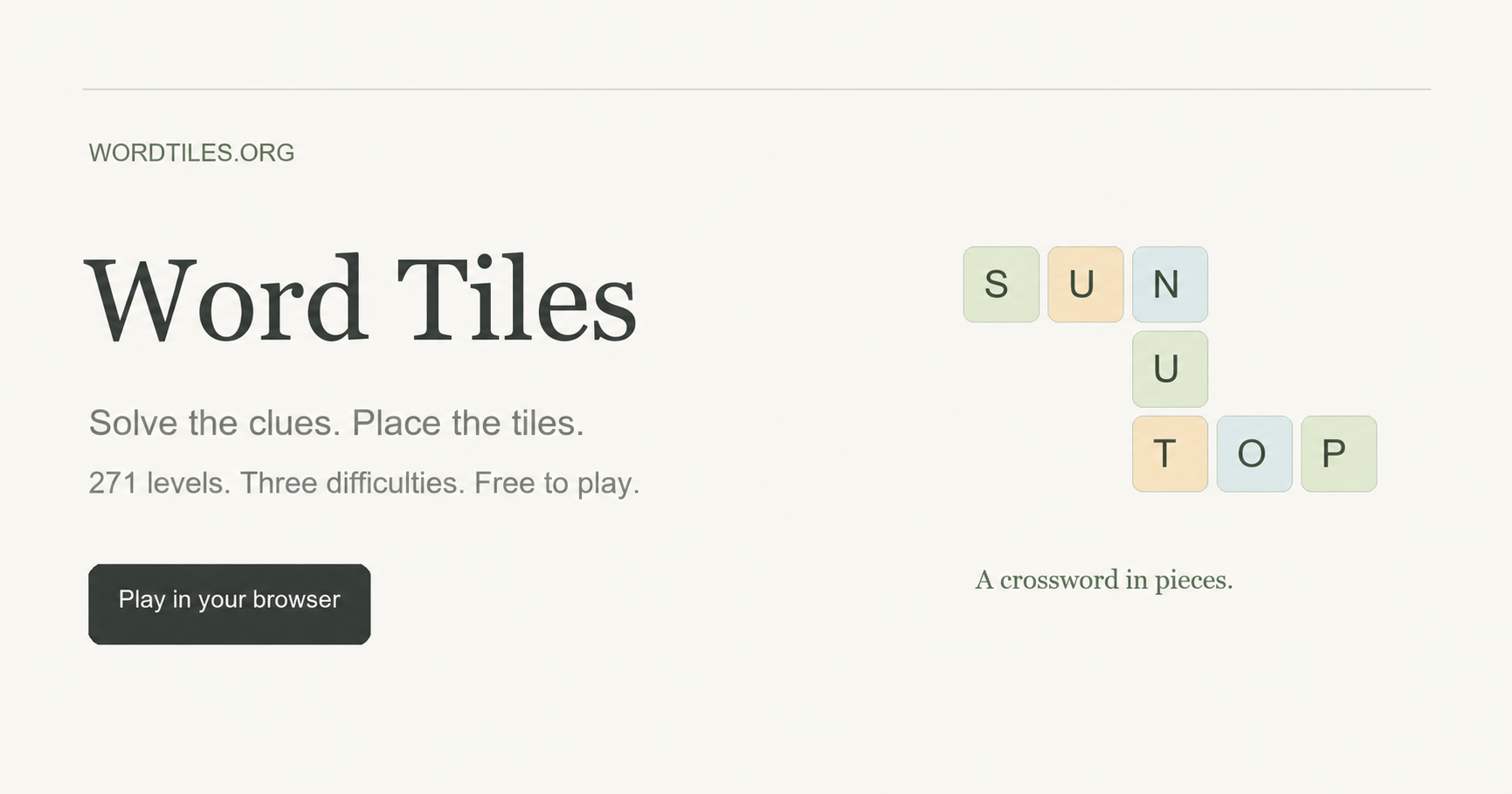
Word Tiles, a browser game on a site I manage, provides a concrete example. Its Normal level 1, First Crossings, has a three-by-four board, two pieces, and three words. Those small numbers make it a useful setting for learning how the letter pieces interact with a crossword. You can observe an entire arrangement without having to track a large pile of pieces.
The game uses a marked letter as the placement reference. Normal pieces keep a fixed orientation. Hard and Ultra add clockwise quarter-turn rotation, but never flipping. If you move between difficulties, remember that the set of available moves has changed. An arrangement impossible in Normal might require a rotation elsewhere, not a different clue answer.
Choose a stopping point instead of chasing a streak
Numbered puzzles and daily puzzles encourage different habits. A daily puzzle gives everyone a shared prompt, which can be enjoyable for comparison and conversation. A numbered collection gives you more control over which challenge to attempt and when to continue. Neither structure is automatically better.
For an interrupted day, it can help to decide on a small goal: learn the controls, complete one level, or resolve one uncertain crossing. The goal should describe something you can recognize. “Get better at word games” is too broad to tell you when to close the tab.
In this example, there is no countdown and no daily reset to wait for. The collection currently lists 271 levels across Normal, Hard, and Ultra. The first ten levels of each difficulty are available initially, with later levels unlocking in order. Progress is separate for each difficulty, so choosing an easier board does not require abandoning the harder collection.
Those details matter more than the size of the collection alone. A large list is not much help if you cannot find a reasonable starting point or resume an unfinished attempt.
Treat help as a change you should inspect
A hint can alter more than the piece you were watching. In Word Tiles, it places one piece in a reference position and returns conflicting pieces to the tray. That means a board can look less complete immediately after receiving help.
Instead of interpreting that as lost progress, ask what conflict was exposed. Was a plausible clue answer sitting in the wrong place? Did a neighboring piece block the reference placement? Understanding the change gives you something to use on another level.
Undo is useful for comparing arrangements while the page remains open, including changes made by hints or restarting. It should not be mistaken for a permanent history of every previous session. If your stopping routine depends on reconstructing ten earlier moves after reopening a tab, check the game’s limits first.
Know what a browser save does not promise
Local saving is convenient because it removes the need to create an account before playing. It also creates a boundary that is easy to overlook: the save belongs to that browser environment. Opening the same website on a different device does not imply that the same board will appear.
The documented behavior here is that completed levels and current placements remain in the same browser. There is no account-based cross-device synchronization. If you expect to continue later, use the same browser and avoid treating a bookmark as a backup of your progress.
The rules and control details are collected in the Word Tiles playing guide. I have used the game as an example because its combination of words, shapes, and local saves makes these distinctions visible, not because every puzzle session needs the same routine.
Before leaving any puzzle, try asking three questions: what do I know, what am I testing, and what will still be saved? A clear answer to each can make an unfinished board much easier to return to.