
Three questions to ask before planning a PokeSurvivor build
A PokeSurvivor run can go wrong in several different ways while producing the same result: you lose before the build starts working. That makes advice such as “pick stronger upgrades” difficult to use. Stronger at what, and at which point in the run? Before choosing a partner or planning an evolution, I would separate the decisions into three questions: what can I use now, what am I preparing for, and what progress will remain afterward?
This is a practical way to read the game’s choices, not a tested ranking of every possible build. It also helps explain why a sensible plan can still fail without making the plan worthless.
Start with an attack you can actually use
The first distinction is between learning an attack and using it. PokeSurvivor normally casts from the selected attack slot. Learning additional moves gives you alternatives to select; it does not mean every learned move continuously fires alongside the others. Effects already on the field can persist after switching, so the amount of activity on screen is not a reliable guide to which slot is currently attacking.
That changes the question to ask when a new move appears. Instead of asking only whether its damage number looks impressive, ask when you would switch to it. Does it offer an option your current attack lacks? Can you identify a situation where selecting it would help? If not, improving the attack you already rely on may be easier to evaluate than adding another choice.
This is not an argument against variety. It is an argument for giving each slot a purpose. A collection of possibilities is useful only when you know when to use them.
Separate a present benefit from a future requirement
Evolution planning introduces another kind of decision. A card can matter because it helps immediately, because it satisfies a later requirement, or both. Treating those reasons as identical makes it easy to misunderstand what a build still needs.
For a concrete example, the guide records Ember reaching level 5 and a Power card obtained during the run as prerequisites for the gold Fire Blast evolution choice. Increasing a permanent upgrade in a menu does not replace that run-specific card. When checking why an evolution has not appeared, those are separate boxes to inspect.
A short note is enough: move, required level, required run card, and whether the evolution choice has actually been offered. Avoid recording only “working toward Fire Blast.” That phrase describes an intention but does not identify a missing prerequisite.
Meeting a requirement is also different from proving that a choice was the best use of a particular level-up. You still have to survive long enough to benefit. If you repeatedly lose before the planned evolution, review the decisions leading up to it rather than assuming the final upgrade would have solved every earlier problem.
Read the card, then read the situation
A level-up screen provides specific information, but not a complete simulation of the next minute. Damage per hit, cooldown, attack behavior, and the circumstances in which an attack connects are different inputs. A larger displayed hit value is not automatically a measured increase in damage per second, and neither number alone is a survival guarantee.
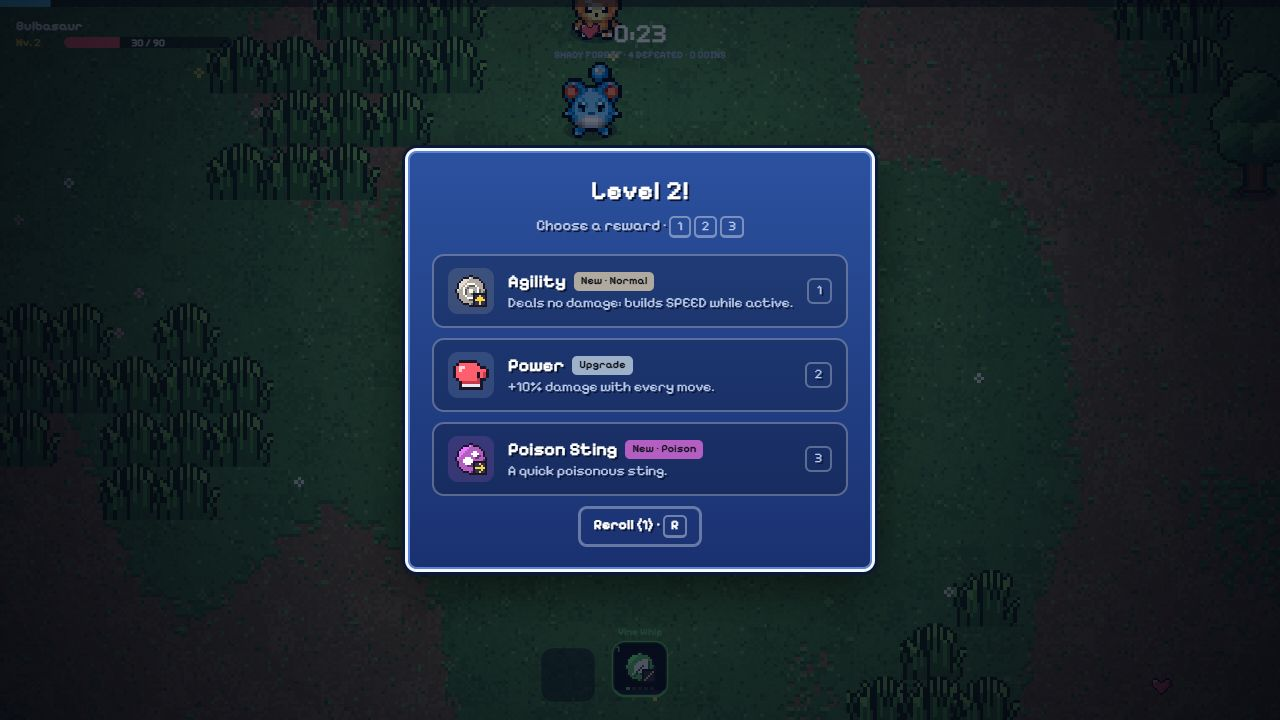
Consider the decision shown in this card-choice screen as a comparison of functions, not a universal answer key. A stat improvement and a move upgrade change different parts of a run. The useful question is which change addresses the limitation you can currently identify. You do not need to claim a statistically optimal build to make that comparison honestly.
For a simple review, write one sentence before the next attempt: “I want this upgrade because…” If the sentence only repeats the card name, make it more specific. You might be supporting an evolution requirement, improving a frequently selected attack, or testing whether another option is useful. Each explanation gives you something to inspect afterward.
Keep collection goals separate from run goals
Unlocking a favorite partner and surviving the current encounter are related interests, but they involve different decisions. Collection systems can encourage expectations that a run cannot satisfy. A rarity guarantee, for example, is not the same as a guarantee of the particular species you want. Choosing a regional pool and receiving a rarity result still leaves the question of which species is selected.
The same caution applies to shiny encounters. Seeing a shiny enemy is not sufficient to add it to your collection; the guide distinguishes encountering it from defeating it. Wild encounters, Rift rewards, and gacha are separate routes, so an explanation of one should not be treated as the rule for all three.
Keeping a separate collection note prevents a frustrating pull from turning into an unrelated change to your combat plan. It also makes the next question clearer: are you checking a reward condition, an unlock, or an attack decision?
Leave yourself one useful observation
After a failed run, a detailed diary is optional. One concrete observation is often more useful than a broad verdict such as “this partner is bad.” Note the selected attack, the upgrade you expected to matter, and what stopped the attempt. Then choose one change for the next run.
This is a way to make comparisons easier, not a claim that a single attempt proves causation. Random choices and different encounters can change the outcome. Keeping most of the plan consistent simply makes your notes less ambiguous.
I maintain the independent PokeSurvivor fan guide, not the game itself. Its beginner page covers the underlying controls and decisions, while the PokeSurvivor cards reference separates individual upgrade effects. Neither replaces in-game results or account support.
Finally, check how your progress is saved before treating a collection session as permanent. The site’s play page launches another operator’s game, and guest progress should not be assumed to persist. Understanding that boundary is less exciting than planning an evolution, but it is part of making a session worth returning to.